
Proven Trenchless Solutions That Keep Your Project Moving
Interconnect Network Constructions delivers high-performance underground infrastructure and trenchless construction services designed to reduce risk, minimise surface disruption, and keep projects on schedule. As an experienced underground infrastructure contractor, we provide reliable solutions for complex civil and utility projects across Sydney, Wollongong, regional New South Wales, and nationwide.
We specialise in Horizontal Directional Drilling (HDD) and trenchless utility installation services for water mains, sewer mains, gas pipelines, telecommunications conduits, and electrical ducting. Using modern drilling equipment and proven construction methods, we deliver precise, efficient trenchless drilling solutions tailored to site-specific ground conditions and project requirements.
From complex HDD crossings beneath roads, railways, and waterways to single and multi-conduit installations within a single bore, our experienced team manages every stage of the project with a strong focus on safety, quality control, and operational efficiency. We work closely with asset owners, civil contractors, and utility providers to deliver cost-effective underground utility solutions that perform long-term across all ground conditions and project sizes.
When accuracy matters and downtime isn’t an option, Interconnect Network Constructions delivers dependable Horizontal Directional Drilling (HDD) and trenchless construction solutions that keep critical infrastructure projects moving—locally and nationwide.
-
Horizontal Directional Drilling (HDD) is a trenchless construction technique used to install underground utilities by drilling a guided horizontal or curved bore along a predetermined alignment, eliminating the need for open trench excavation. The process consists of drilling a pilot hole, enlarging it by reaming to the required diameter, and pulling the pipeline or conduits back through the bore.
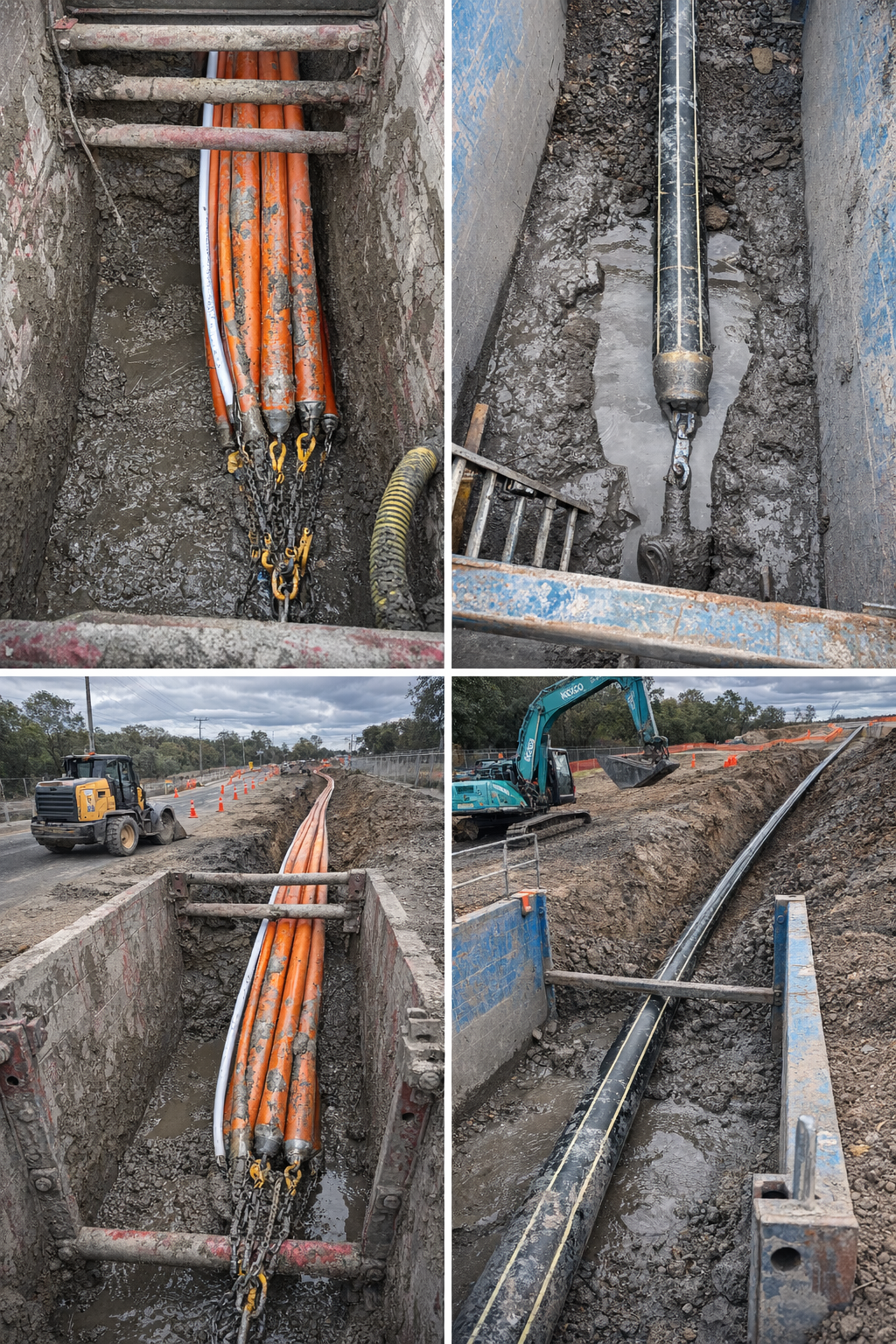
Installing various underground PE pipe sizes refers to the use of polyethylene (PE/HDPE) pipes and conduits of different diameters installed by HDD for all major underground mains, including water, sewer, telecommunications, gas, and electricity. PE pipes are typically fusion-welded into continuous, joint-free lengths and installed in a single pull, providing a durable, leak-resistant system.
Typical applications and PE pipe size ranges include:
Water mains: 90–1200 mm for potable and non-potable supply lines
Sewer and force mains: 110–1200 mm for gravity sewers, pressure sewers, and force mains
Gas mains: 50–250 mm
Telecommunications: 50–125 mm for fibre-optic and communication conduits
Electricity: 50–225 mm for power cable conduits and duct banks
HDD also allows for the installation of single large conduits or multiple PE conduits within one bore hole, using spacers or bundled configurations. This approach is commonly used for utility corridors and duct banks, improving efficiency while minimizing surface disturbance.
Overall, HDD provides a reliable, precise, and environmentally friendly solution for installing PE underground mains beneath roads, railways, waterways, and developed or sensitive areas.
-
Rock drilling in Horizontal Directional Drilling (HDD) refers to the specialized HDD process used when the bore path passes through hard or abrasive geological formations such as bedrock, limestone, sandstone, shale, or cobbles.
In rock HDD, conventional soil-cutting tools are replaced with rock-specific drilling assemblies, typically including mud motors with tungsten-carbide or diamond-enhanced drill bits. The downhole motor rotates the bit independently of the drill string, allowing efficient cutting of rock while maintaining precise steering and alignment.
Key characteristics of rock drilling in HDD include:
Use of rock bits (tricone, PDC, or hammer bits) designed for hard formations
Higher drilling pressures and torque compared to soil drilling
Drilling fluid (mud) to cool the bit, stabilize the bore, and remove rock cuttings
Slower advance rates but greater accuracy and bore stability
Reaming with rock reamers to enlarge the bore for final pipe installation
Rock drilling in HDD enables the installation of pipelines and conduits where open excavation or conventional boring is impractical, such as beneath rivers, highways, railways, and urban infrastructure. It is commonly used for installing PE and other utility pipes for water, sewer, gas, telecommunications, and electrical mains in challenging ground conditions.
-
Sand, Clay & Shale Drilling
Horizontal Directional Drilling (HDD) can be performed in a range of ground conditions, including sand, clay, and shale, each requiring specific equipment and fluid management to maintain bore stability and ensure successful pipe installation.
Sand Drilling involves loose, granular soils where bore stability is critical. It requires specialised soil-cutting bits and high-volume drilling fluid to support the bore walls, prevent collapse, and carry sand cuttings to the surface. Careful control of pressure and fluid circulation is essential.
Clay Drilling is performed in cohesive soils that naturally help maintain bore stability. Standard clay or soil bits are used, with controlled drilling fluids to prevent swelling or stickiness. Clay conditions typically allow good steering control and efficient drilling progress.
Shale Drilling involves harder, layered rock formations. Mud motors and rock-specific bits (such as PDC or tricone) are used to handle abrasive material and maintain directional accuracy. Drilling is slower than in soils but provides precise, stable bores for longer crossings.
When properly managed, HDD in sand, clay, or shale enables the safe installation of PE pipes and conduits for water, sewer, gas, telecommunications, and electrical utilities with minimal surface disturbance.
-
Underground Service Location & Non-Destructive Digging (NDD)
The safe identification and exposure of existing underground utilities before excavation works.
Underground Service Location: Detection and marking of buried services such as water, gas, electricity, telecommunications, and sewer to prevent damage and ensure compliance.
Non-Destructive Digging (NDD): A vacuum excavation method that uses high-pressure water or air to safely expose underground services without damaging them, reducing risk and maintaining site safety.
-
Trenching
Excavating narrow trenches in the ground to install underground telecommunications ducts and cables.
Pit Installation
Installing underground access chambers that provide entry points for pulling, jointing, and maintaining telecom cables.
Pipe (Duct) Installation
Placing protective conduits underground to create secure pathways for telecommunications cables between pits.
-
Project Management
Professional coordination of planning, resources, timelines, and budgets to ensure projects are delivered safely, on time, and within scope. -
Traffic Control Management
The coordination and supervision of traffic measures to ensure the safety of workers, motorists, cyclists, and pedestrians during roadworks or telecom construction.
Traffic Management Plan (TMP)
A documented plan outlining signage, lane closures, detours, and safety controls required to safely manage traffic during works on or near a roadway.
Road Occupancy Licence (ROL)
An official permit issued by the road authority that allows approved works to occupy or impact a public road or road reserve for a specified period.
-
Fibre Optic Cable Hauling
The installation of fibre optic cables by carefully pulling or air-blowing them through underground ducts or conduits, ensuring minimal stress and protection of the cable to maintain performance.Fibre Optic Cable Splicing
The precise joining of fibre optic fibres using fusion or mechanical methods to create a seamless, low-loss connection within the telecommunications network -
Concrete, Pavers & Grass Restorations
The repair and reinstatement of surfaces disturbed during civil works, restoring areas to their original condition and standard.
Concrete Restoration: Removal and replacement of damaged concrete such as footpaths, driveways, kerbs, and slabs, ensuring correct levels, finish, and compliance with local standards.
Paver Restoration: Careful lifting and reinstatement or replacement of paving stones and brickwork, including proper base preparation and re-levelling to match existing surfaces.
Grass Restoration: Backfilling and compacting excavated areas, applying topsoil, and re-turfing or seeding lawns and landscaped areas to restore their original appearance.
Our Process
Plan with Purpose
We collaborate with you to develop a smart, achievable strategy that aligns with your goals and sets your project up for success.
Collaborate Openly
We believe the best results come from transparency. You stay informed, involved, and confident as decisions are made together.
Plan with Purpose
No two projects are the same. We plan strategically and stay agile, tailoring our process to fit your schedule, scope, and site conditions.
Plan with Purpose
Our work goes beyond completion. We deliver dependable, long-term solutions backed by experience, care, and commitment.